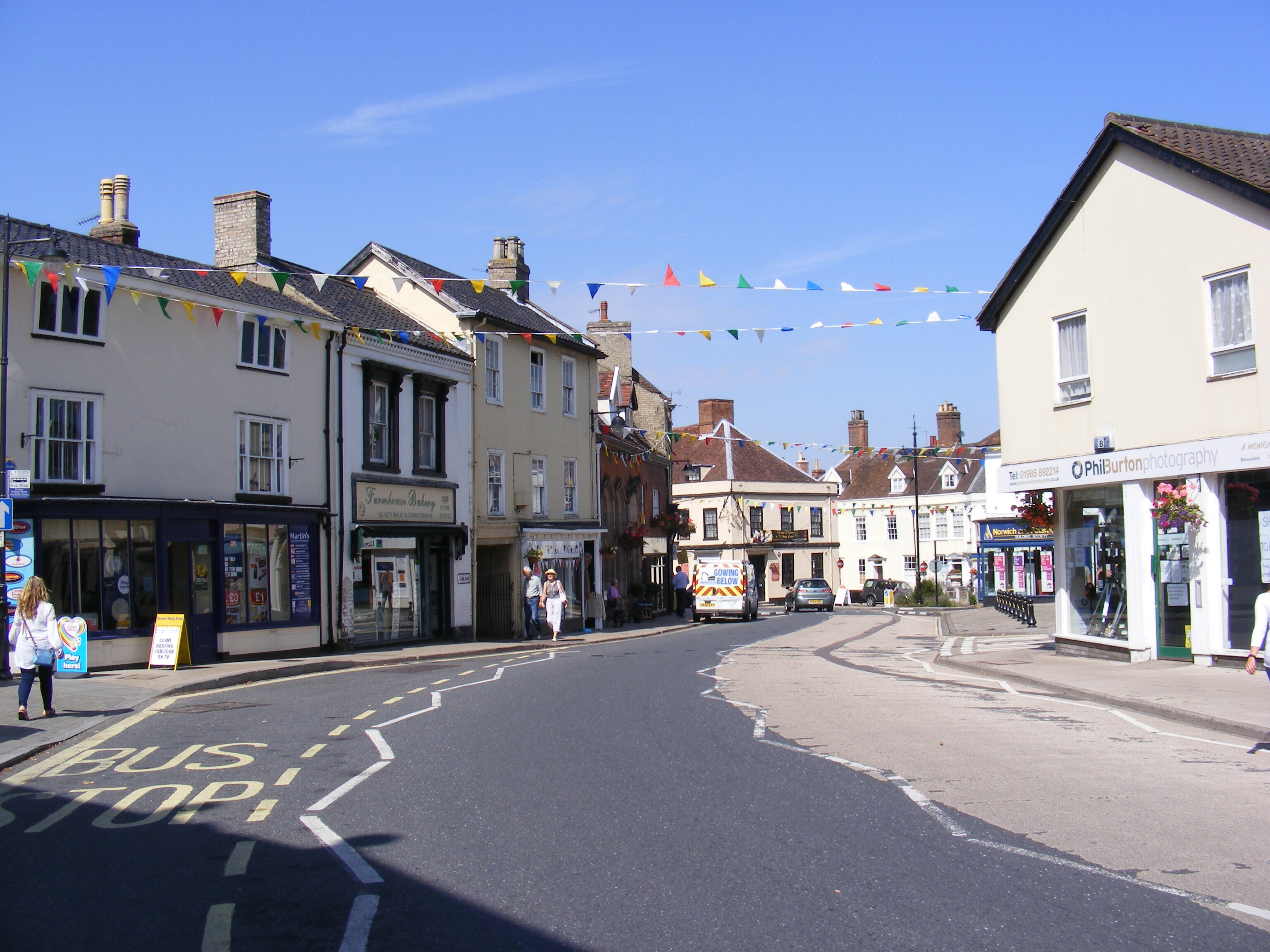
Bungay is one of the more distinctive market towns on the Suffolk-Norfolk border, an unusually intact medieval town set within a loop of the River Waveney, with the ruins of a Norman castle at its centre, a well-regarded 11 to 18 secondary school, one of the oldest working provincial theatres in the country and a run of independent food shops that has made the town a genuine destination in the last decade. Set fifteen miles south-east of Norwich, six miles from Beccles and thirty miles north of Ipswich, Bungay draws families, downsizers, buyers from Norwich and buyers from London looking for a working community at a more accessible price point than the Suffolk coast.
What makes Bungay appealing is the combination of setting and everyday practicality. The Waveney wraps almost all the way around the town, providing walking, canoeing and paddleboarding access straight from the centre. Earsham Street brings one of the strongest small-town independent shopping streets in the region. The Fisher Theatre runs a full year-round arts programme. Two annual festivals, Black Shuck in August and the Bungay Folk Festival, anchor the community calendar. And prices sit slightly below the East Suffolk average.
What is Bungay known for?
Bungay's most obvious asset is its Norman castle. Bigod's Castle, dating from 1165 and one of the strongholds of the powerful Bigod family, sits in the middle of the town with its walls and two great towers still standing to substantial height. Entry is free and access is via a small visitor centre and café. The wider Bigod's Way walking trail runs ten miles around the town.
The town's other headline story is the Black Shuck legend. On 4 August 1577, in a violent storm, a large black dog is said to have entered Bungay's St Mary's Church during a service, killing two members of the congregation and leaving scorch marks on the church door before reappearing at Blythburgh church further south. The story has passed into East Anglian folklore, and the Black Shuck Festival, established in 2022, was set up to reclaim the legend for the town and now anchors the first weekend of August.
Bungay has a strong food and drink profile. The Green Dragon, founded in 1991 by brothers Robert and William Pickard, is the town's oldest working brewery. Earsham Street has become a small-scale destination for artisan producers, with the award-winning EarshamStreet Deli, the upmarket Giddens & Thompson green grocer, and a run of independent cafés, bakeries and food shops that has drawn visitors from Norwich, Beccles and further afield.
Property Market in Bungay
Bungay offers a varied and consistently active property market. Period cottages line St Mary's Street, Bridge Street and Cross Street, larger Georgian and Victorian houses sit along Broad Street and Ditchingham Dam, and there is a steady supply of newer family homes on the edges of the town. Surrounding settlements at Ditchingham, Earsham, Ilketshall St Andrew, Mettingham and Homersfield bring further options, including period cottages, farmhouses and hall houses along the Waveney.
Demand is driven by Norwich commuters using the A146, by families settled here for Bungay High School and the primary, by downsizers drawn to the walkability and the services, and by buyers from London and the South East looking for character at a sensible price. The market is more accessible than the well-known Suffolk coastal towns and than the higher-priced Waveney villages downstream.
Is Bungay expensive?
By Suffolk standards, Bungay sits below the middle of the market. Recent sold-price data puts the Bungay average at around £269,000, with detached houses averaging around £332,000 and terraced properties around £232,000. That sits slightly below the wider East Suffolk average of £280,000 in May 2026 reported by the ONS, and well below the coastal premium spots.
In practice, the highest values attach to the larger period houses on Broad Street, Bridge Street and the streets running down to the Waveney, and to converted barns and farmhouses in the surrounding villages. The market has shown steady long-term support, driven by the schools, the services, the strength of the wider Waveney Valley and the pull of the independent food and drink scene.
Arrange a Property Valuation
Please do get in touch if you are considering selling in the area and one of our experienced agents will be delighted to help. Contact us on 01473 218218
Schools and Education
Bungay has one of the stronger education offers of any small market town in the East of England, with a Good-rated 11 to 18 secondary and a Good-rated primary within the town itself.
Primary Schools
Bungay Primary School is the main primary in the town, taking children from age 3 to 11. The school received a Good rating from Ofsted at its May 2021 inspection and is part of the East Anglian Schools Trust. Several village primaries within the wider catchment also feed the town, including Earsham CofE Primary and Ilketshall St Lawrence Primary.
Secondary Schools
Bungay High School on Queen's Road is the main state secondary, currently catering for students aged 11 to 18. The school holds a Good rating from Ofsted based on its November 2021 inspection and is a founding partner of the East Anglian Schools Trust established in 2019. The school was founded in 1565 by Lionel Throckmorton as Bungay Grammar School, becoming Bungay High School in 1974.
The Trust has confirmed that the sixth form is closing at the end of the 2025-2026 academic year, following a sustained decline in Year 12 applications. Post-16 provision for Bungay families will therefore be drawn from East Coast College at Lowestoft, City College Norwich, Sir John Leman High School at Beccles, or independent sixth forms in the wider area.
Independent Schools
Independent options within reach include Norwich School and Norwich High School for Girls in Norwich, around thirty minutes to the north; Saint Felix at Reydon near Southwold, around twenty-five minutes to the south-east; and Framlingham College further south, within around forty-five minutes.
Further Education
East Coast College at Lowestoft and Great Yarmouth provides further education, T Levels and apprenticeships within around thirty minutes by road. City College Norwich is around thirty minutes north, and the University of East Anglia in Norwich offers degree-level study within reasonable commuting distance.
Getting Around
Bungay does not have its own railway station, the branch line having closed in the 1950s, but the town is well-served by road and by the local bus network. The nearest mainline stations are Beccles, six miles east, on the East Suffolk Line, and Diss, around fifteen miles south-west, on the Great Eastern Main Line. Beccles trains run to Ipswich in around an hour and to Lowestoft in around thirty minutes; Diss trains run direct to London Liverpool Street in around ninety minutes.
First's X41 bus runs regularly between Bungay and Norwich, with a journey time of around 45 minutes and departures every 15 minutes at peak times. Other bus routes connect the town with Beccles, Halesworth and the wider Waveney Valley, and Border Bus operatesservices further east into the Southwold area.
By road, the A143 runs directly through the town, providing a direct route east to Beccles and Great Yarmouth and west to Diss and Bury St Edmunds. The A146, four miles east, connects to Norwich and Lowestoft. Norwich Airport is around fifteen miles north, London Stansted around eighty miles south, and Great Yarmouth and Lowestoft are within around forty minutes for ferry and North Sea coastal access.
The Waveney, the Broads and the Outdoors
The River Waveney is Bungay's defining outdoor asset. The river loops around most of the town, and public footpaths along the water and out into Outney Common give the town some of the more accessible waterside walking in the East of England. Outney Common itself, a 400-acre area of grazing marsh and meadow, is one of the largest common lands in the county and provides open walking country a few minutes from the town centre.
The Waveney is popular for canoeing, kayaking and paddleboarding, with Outney Meadow Caravan and Camping and Three Rivers both hiring out craft from the town. The Bungay Paddle Loop, a 6.8 kilometre circular route around the town by water, takes around three hours and is one of the more popular short paddling routes on the river.
The wider Waveney Valley leads east into the Broads National Park, the largest protected wetland in the UK, within around fifteen minutes by road. The Bigod's Way, a ten-mile walking trail, runs a full loop around Bungay through Ditchingham, Earsham and the surrounding villages.
Things to Do in Bungay
Bigod's Castle
The Norman castle at the centre of the town, dating from 1165, retains its two great towers and substantial curtain walls. Entry is free, with access through the Castle Visitors Centre which provides refreshments and small exhibitions on the castle's history and the Bigod family.
St Mary's Church
The 14th-century parish church, best known outside Bungay for the 1577 Black Shuck legend, sits at the centre of the town and runs a regular programme of services and community events. The adjacent ruined nave of the earlier Priory Church is one of the more atmospheric small heritage sites in the region.
Fisher Theatre
The Fisher Theatre on Broad Street was built by David Fisher I in 1828 as one of thirteen touring theatres he built across East Anglia. It was sold as a working theatre in 1844, later serving as the town's Corn Hall, a cinema and various other uses, before being acquired by the Bungay Arts Trust in 2000 and reopened as a community theatre in 2006 following extensive restoration. It now runs a full year-round programme of drama, live music, film, comedy and community events, and is a genuine anchor of the town's cultural life.
Norfolk and Suffolk Aviation Museum
The Norfolk and Suffolk Aviation Museum at Flixton, three miles south-east of Bungay, sits on the site of the former USAAF 446th Bomb Group airfield and holds a substantial collection of aircraft, engines and wartime memorabilia. Entry is free.
Outney Common and the Waveney
Outney Common, the loop of the Waveney around the town, and the Bigod's Way trail together provide the most-used outdoor recreation for Bungay residents. Canoe and paddleboard hire is available in the town.
Community Life and Events
Bungay has a busy community calendar for a town of its size, with two major festivals anchoring the year and a strong programme of arts, music and community events through the Fisher Theatre and the wider town.
Black Shuck Festival
Held over the first weekend of August each year, the Black Shuck Festival was established in 2022 to reclaim the 1577 legend for the town. It runs a mix of music, storytelling, family events and community stalls across the town, with the 2026 festival scheduled for 1 August.
Bungay Folk Festival
The Bungay Folk Festival runs each September, with a programme of folk music, dance and workshops across venues in the town and at Outney Common.
Fisher Theatre Programme
The Fisher Theatre runs a full year-round programme of drama, live music, film, comedy, community events and children's productions, and remains the anchor of Bungay's cultural life.
Farmers' and Community Markets
Regular farmers' and community markets run through the year in the town centre, alongside seasonal Christmas markets and late-night shopping evenings.
Dining and Drinking
Bungay's food and drink offer is one of the strongest for a small town in the East of England, headed by the Fleece Inn and the Green Dragon and complemented by an unusually strong run of independent food shops and cafés on Earsham Street.
Pubs
The Fleece Inn, serving Bungay since the 15th century, is one of the highest-rated pubs in the town, with exposed timbers, low ceilings, leaded windows overlooking St Mary's Church and a menu built around seasonal produce and local ales. It currently sits near the top of the Tripadvisor rankings for Bungay.
The Green Dragon, founded in 1991 by brothers Robert and William Pickard, is the town's oldest working brewery and one of its busiest pubs, with a menu that combines international small plates (Portuguese sandwiches, Canadian poutine, bao buns) with pub classics. The Kings Head, the Butter Cross and the Chequers Inn round out the town pub offer.
Restaurants and Cafés
A run of independent cafés, small restaurants and lunch spots line Earsham Street and the town centre. The Earsham Street Deli, Giddens & Thompson green grocer, several artisan bakeries and small independents provide a strong daytime food scene.
Waveney Valley Country Dining
Country pubs in the surrounding villages, particularly The Ferry Inn at Geldeston (with its riverside setting on the Waveney), The White Horse at Barnby and The Locks Inn at Geldeston, sit within around fifteen minutes for wider evening dining.
Shopping
Bungay has an unusually strong independent shopping offer for a town of its size, dominated by small local businesses across the Market Place, Earsham Street and St Mary's Street.
Earsham Street is the town's food and drink destination, with Giddens & Thompson green grocer, the award-winning Earsham Street Deli, and a run of specialist bakeries, cheesemongers and small food shops. The wider retail mix covers gifts, homewares, fashion, antiques, books and a good run of independent service businesses. Fuzzy Pegs Folk Art on Earsham Street covers folk art, gifts, homeware and toys.
For larger shopping trips, Norwich is around thirty minutes north with a full city offer including Chapelfield, Castle Quarter and John Lewis, and Beccles is six miles east with a smaller high street of independents and multiples.
Golf and Fitness
Bungay & Waveney Valley Golf Club, on the northern edge of the town, is a long-established 18-hole heathland course on Outney Common, dating from 1889 and one of the older clubs in East Anglia. Diss Golf Club, fifteen miles west, and Halesworth Golf Club, twelve miles south, provide two further parkland options within easy reach.
Bungay Recreation Ground and the town's community sport facilities provide the everyday sport spine, and Outney Common and the Waveney together provide some of the more distinctive running, cycling and paddling country in the region. Waveney Valley Leisure Centre is accessible for wider fitness and pool use.
Why Bungay
Bungay works because the parts hold together. A Norman castle, a 15th-century church with a legend older than most, a Good-rated 11 to 18 secondary and a Good-rated primary in the town itself, and one of the strongest independent High Street food scenes in the East of England. The Waveney loops around the town for the outdoors. The Fisher Theatre and the Black Shuck and Folk Festivals for the arts. Beccles and Diss stations handle the London commute, and prices remain accessible against the coastal towns.
If you are thinking about buying or selling in Bungay or the surrounding villages, our team would be glad to help. Contact us on 01473 218218
The information in this guide was last updated in October 2026.

How can we help?
Book a market appraisal and discover the true potential of your property:

Find Your Local Branch
Speak to people who, quite simply, love their patch and love what they do.