Shared values
The impact of confidence in pricing
Buyers and sellers alike in the middle to upper market know that both have access to the same huge wealth of market information. There is an essential caveat here in relation to more idiosyncratic and larger country houses, but even there the additional evidence which we collate is, in the interests of both sides, often made available to both.
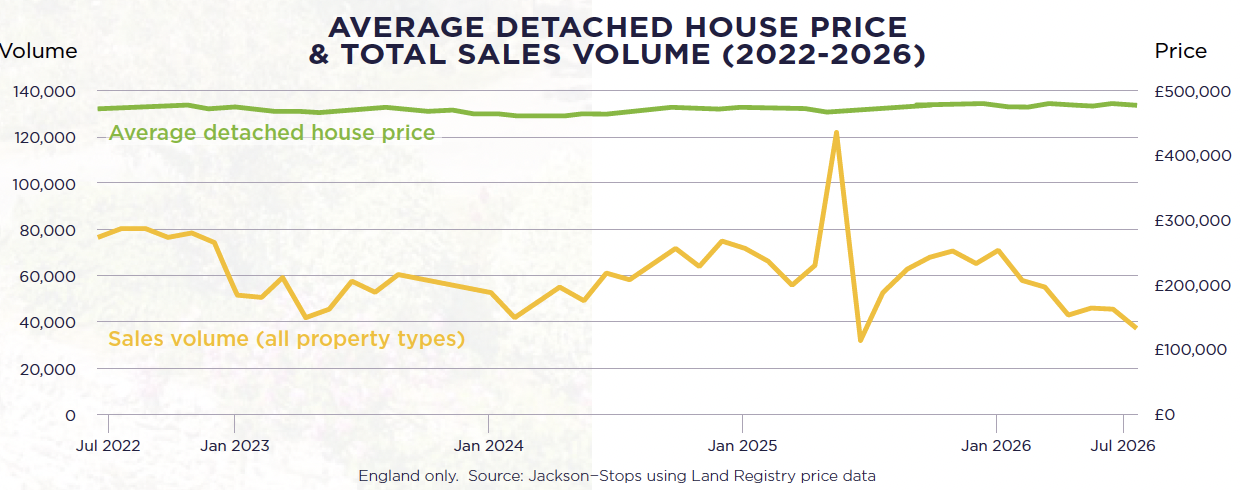
Coupled with largely static or softening prices (see graph) this has quietly resulted in something most unusual: price is no longer the greatest obstacle. Timing − the ability for buyer and seller to get their proverbial ducks in a row − is. Even this, in a market dominated by people with pressing, ‘stage of life’ reasons to buy and sell, is not the obstacle it was, because everyone involved has to move. They are of serious intent. When offers are discussed but not finalised, both sides will go off to tackle their remaining hurdles − finding a buyer for a dependent sale, securing mortgage offers, securing probate etc. − confident that, once in a position to transact, it should be possible to agree a price: they are already in the same ball park. Echoing this (and that serious intent), fall−throughs due to late disagreement on price, are rare at the moment. Things can still get personal though: one cash bidder who demanded a discount on the accepted value of a house ‘on principle’, caused such offence as to be given a very firm refusal − also ‘on principle’.
An alternative buyer at the accepted value was found soon after. One problem faced by buyers hoping to get a good deal by being able to move fast is that too many owners can’t match that speed anyway − they haven’t sorted out their documentation, fixed the off−putting repairs or even told their solicitor. This is a regular refrain of this column, but one which warrants repeating: proper preparation makes it easier for potential buyers to believe that a deal will go through swiftly and so commit more deeply to buying, often at a higher price.
Rewards for buyers who register
Geographically, whether would-be buyers register with us (so we can tell them as soon as the right house comes up, rather than them contacting us only when it does) varies wildly.
Perhaps it’s cultural? Either way, in some areas it is the norm, in others, a rarity. It matters because greater confidence around pricing is leading more owners who are keen to prioritise privacy, to ask us to find a buyer ‘off−market’, ie without the multi-platform high exposure that modern online marketing inevitably involves. When they do, we can only call you, if we know you are there. So it’s worth doing.
That geographical variation though, means that while this approach is proving highly successful in some regions, it’s inadvisable in others: all of that marketing, online and off, is needed in the fight for attention and generating competition.
Historically, incidentally, such open market testing was regarded by lawyers in probate sales as necessary to demonstrate that the best price had been achieved. Today, the aforementioned wealth of market information appears to have made this much less of an issue.
A slightly less welcome (for us) consequence of static prices has arisen through their coincidence with new tenant rights. Historically, the ‘hottest’ of our serious buyers with an unavoidable reason to buy were those who had sold and were renting while house hunting. The new Renters’ Rights legislation has caused these buyers to wake up to a new found freedom…and relax. They don’t have to move! Brendan May of the Oundle office explained how this group has gone from having a fixed date by which they must give up their home, to being able to give two months’ notice whenever they wish. “They are feeling really comfortable” says Brendan “and slower to commit as a result.” On the plus side, the combination of price stability, two months’ notice and improving affordability as incomes rise, is encouraging more long−term renters to take the plunge and buy. It is also far easier for us to coordinate completion dates to suit both parties.
Northern power house
In striking contrast to this ‘normal’ world of dependent sales, mortgage offers and static prices, primarily in the £700,000 to £1.2 million range, our Greater Manchester and Cheshire offices have enjoyed a remarkable run of successful top−end transactions over recent months. Sales this year have averaged around £2 million per property and they have their strongest sales pipeline in at least two years.
This includes an unusually busy August. It is, they are swift to point out, a highly localised and statistically small market, dominated not by salaried people with children and mortgages, but by those who have, for example, sold their substantial tech companies, done well from their private equity businesses, or are part of the Premier League world. These buyers hold cash: when interest rates go up, they have more money, not less. At the moment, they are spending it. One suspects that not many of them take the time to search price histories and comparable sales.