Greater Certainty Over Home-Moving Process Could Unlock 260,000 Homes Across England Within a Year
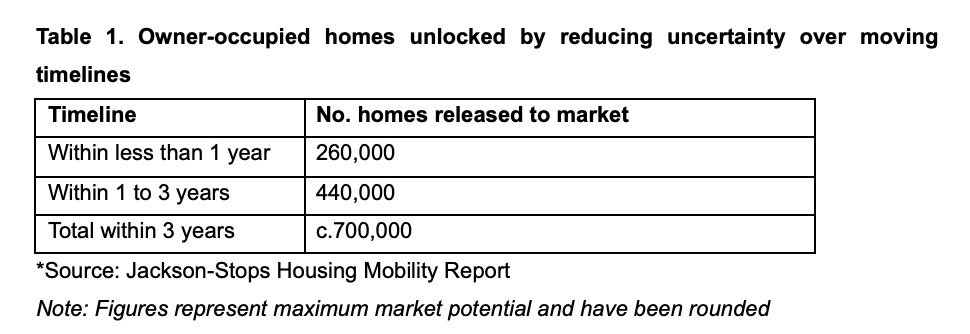
- This represents the first wave of potential market supply, rising to over 700,000 homes over three years if uncertainty over transaction timelines is reduced
- The near-term figure alone is greater than the total number of homes in the city of Manchester
- The report comes after the Government published its roadmap for reforming the home buying and selling process last month, which it says could cut transaction times by around four weeks
- UK-wide residential transactions show completions reached over 1.21 million in the 2024 to 2025 financial year, up from around 1 million in 2023 to 2024
- Stamp duty was cited by 28% of affected owner-occupiers as a barrier to moving, highlighting the role upfront costs play in housing mobility
Greater certainty over home moving timelines could unlock over 260,000 owner-occupied homes for the housing market in England within less than a year, according to the new Jackson-Stops Housing Mobility Report.
The report’s national analysis points to a housing mobility challenge across England, with uncertainty over transaction timelines across the wider industry holding back potential supply before homes reach the open market.
The headline figure of over 260,000 homes represents the first wave of latent housing supply that could be unlocked if uncertainty over transaction timelines was reduced, with the figure rising to over 700,000 owner-occupied homes over the next three years (see Table 1). To put the near-term figure in context, the 260,000 homes that could be unlocked within less than a year is greater than the total number of homes in the city of Manchester.
The research follows the Government last month publishing its roadmap for reforming the home buying and selling process, with proposals designed to speed up transaction times, reduce delays, improve upfront information sharing and give buyers and sellers greater confidence earlier in the transaction process. With the Government stating that its reforms could cut transaction times by around four weeks, Jackson-Stops’ research suggests that greater certainty over moving timelines could unlock a significant pool of would-be movers waiting in the wings.
Government data published as part of the reform roadmap shows the scale of the current challenge facing the market, with the average home purchase taking around 120 days once an offer is accepted, around one in three transactions falling through, and failed transactions currently costing the wider economy up to £1.5 billion annually.
Nick Leeming, Chairman of Jackson-Stops, comments: “Our Housing Mobility Report highlights an industry-wide challenge facing the English housing market, with would-be movers hesitating before they even begin.
“The Government’s proposed reforms are a positive and necessary step. Measures that improve upfront information sharing, strengthen professional standards and provide greater certainty earlier in the process should help buyers and sellers move with more confidence.
“The key now will be implementation, ensuring the reforms are phased carefully, clearly understood by consumers and workable for the agents, conveyancers, lenders and other professionals who will need to deliver them in practice.
“The market is active, and people continue to buy and sell homes every day. But our research indicates there is a sizeable group sitting behind that activity. People who could move, and in many cases would like to move, but who need greater confidence in the process in order to do so.”
Millennials and upsizers drive activity
Jackson-Stops’ Housing Mobility Report points to continued intent and momentum among owner-occupiers, with 8% in England currently planning to move or already in the process. This sits alongside wider HMRC transaction data indicating that households are continuing to move, with UK-wide residential transactions reaching over 1.2 million in the 2024 to 2025 financial year, up from around 1 million in 2023 to 2024.
The research suggests this activity is being supported by a mix of both practical life-stage and lifestyle-led decisions. Among owner-occupiers who had moved, were considering moving, or had considered moving in the last five years, the leading motivations were moving to a larger home (24%) and relocating to a different area for lifestyle reasons (22%). Millennials were the most active established owner-occupier generation, with 12% currently planning to move or already in the process of moving, compared with 8% of owner-occupiers overall.
Additional findings
The research also makes clear that process uncertainty is not the sole factor shaping moving decisions. Among owner-occupiers whose moving plans had been delayed, postponed or abandoned, the most commonly cited barriers were economic uncertainty (42%), mortgage rates (29%) and stamp duty costs (28%). This makes stamp duty the third most commonly cited barrier among affected owner-occupiers, underlining its potential impact on housing mobility. However, additional process-related issues beyond uncertainty around timelines also featured, including concerns about delays in conveyancing (20%).
Commenting on the findings, Nick Leeming adds: “Stamp duty is clearly part of the wider mobility challenge. While it is not the only factor shaping moving decisions, our polling shows it remains a meaningful barrier for some would-be movers. Any serious discussion about improving housing mobility should consider both the transaction process itself and the upfront costs people face when deciding whether to move.”
The stamp duty finding comes as property taxation is attracting renewed political attention. Andy Burnham is widely reported as the front-runner in the Labour leadership contest, and recent reporting has linked a possible Burnham premiership with property tax reform, including ideas around replacing or reforming stamp duty and council tax. No formal policy has been confirmed, but Jackson-Stops’ polling suggests any future move that reduces upfront costs for movers would be watched closely by the market and may be welcomed by some buyers and sellers.
Late-stage transaction risks also appear to have a strong effect on confidence. Among owner-occupiers whose moving plans had been delayed, postponed or abandoned in the last five years, more than eight in ten who cited ‘gazundering’ – when a buyer lowers their offer before exchange – said they would be likely to move within three years if this barrier was no longer an issue. Among those who cited ‘gazumping’ – when a seller accepts a higher offer from another buyer after already accepting an offer – around six in ten said the same.
Jackson-Stops’ Housing Mobility Report also found that uncertainty over how long the home-moving process would take has delayed, postponed or caused nearly one million owner-occupier households in England to abandon moving plans over the past five years.
Nick Leeming concludes: “There will always be financial and personal reasons why people decide whether or not to move. But this research shows that there is a group of would-be movers who may be encouraged to act if the process feels clearer, more predictable and easier to navigate.
“Improving certainty will not solve every housing challenge, and affordability, mortgage rates and wider economic conditions will continue to shape decisions. But the home-moving process is one practical area where improvement can support confidence.
“A healthier housing market is about more than building new homes, essential though that is. It is also about helping existing homes circulate more freely, so that more people can make the move that is right for them.”